Ilchester, Maryland, Part Four; The Railroad Customer, Bartigis Brothers.

While Ilchester was a small station for an even smaller town, it did have a long history and still had railroad deliveries into the 1950s. Across the Patapsco river on the north side was the Thistle Manufacturing Company. In 1823, four years before the B&O was chartered the land for the factory was purchased from the Ellicott family (the family that settled Ellicott Mills, later called Ellicott City and the first terminus of the B&0). The Thistle Manufacturing Company was chartered in 1834 and was thought to be designed to supply cotton duck to the shipping industry in Baltimore. According to records, it manufactured cloth through the 1800’s.

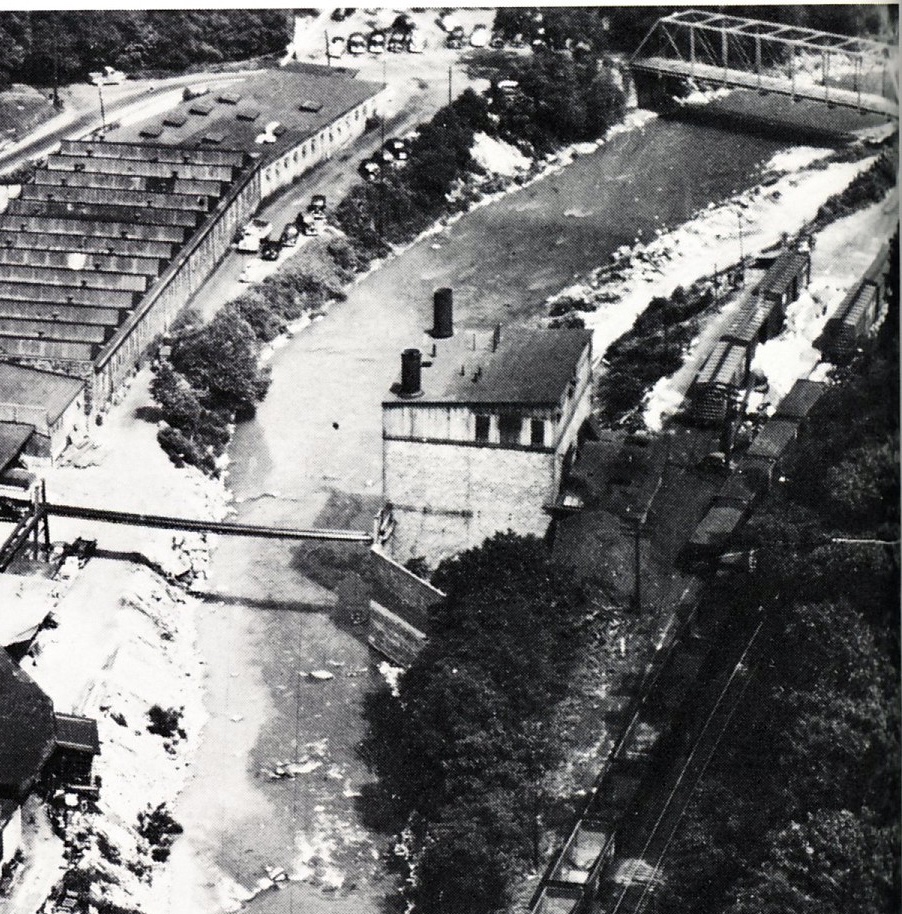
In the early 1920s it began to manufacture automobile tire bands, but by the late 20s was producing cardboard boxes. In 1928 it was sold to Bartgis Brothers and they manufactured boxes until 1957 when it was sold again. Box manufacturing and then paper recycling continued on the site for many years, but it has since been leveled. From a 1940s era aerial photo it appears paper pulp was delivered to the plant in boxcars on the south side of the river. The pulp is the light fluffy substance and appears to be on the ground near boxcars on the north siding track in the aerial photos. It seems to have been shipped in bales like cotton in that era. This intermediate product was likely unloaded from boxcars and trucked north cross the river to the Bartgis Brothers Plant. Swedish paper pulp was an import to Locust Point and may have been a source for Bartis Brothers. A January, 1950 article in the B&O magazine shows imported pulp from Sweden being handled at Locust Point.

It is interesting to note that the plant was connected to the sewer system in 1970 and no longer allowed to dump titanium dioxide directly into the river. This white substance seems to be visible in the aerial photos, now I have to decide whether or not to model the river as polluted or not.

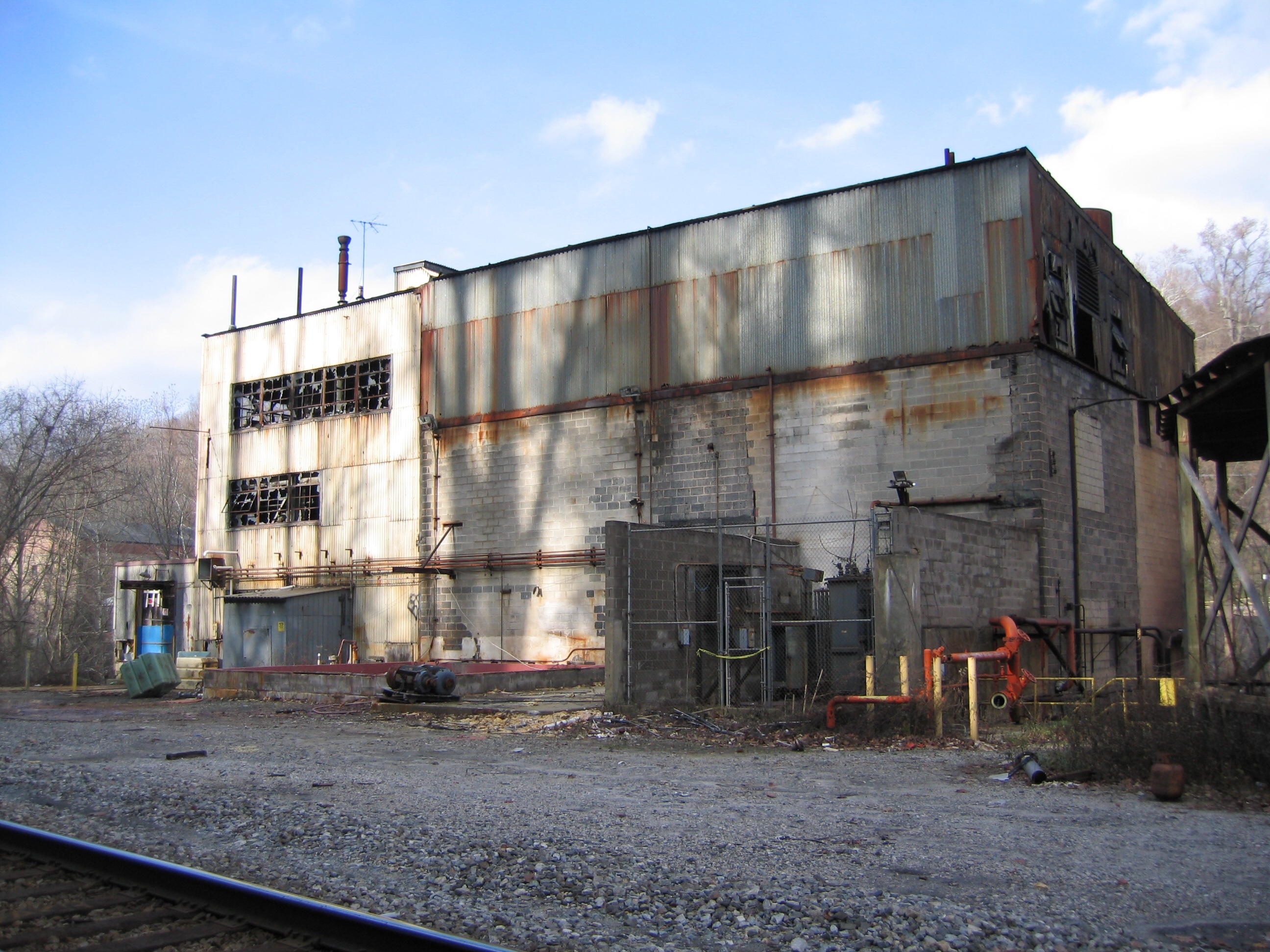
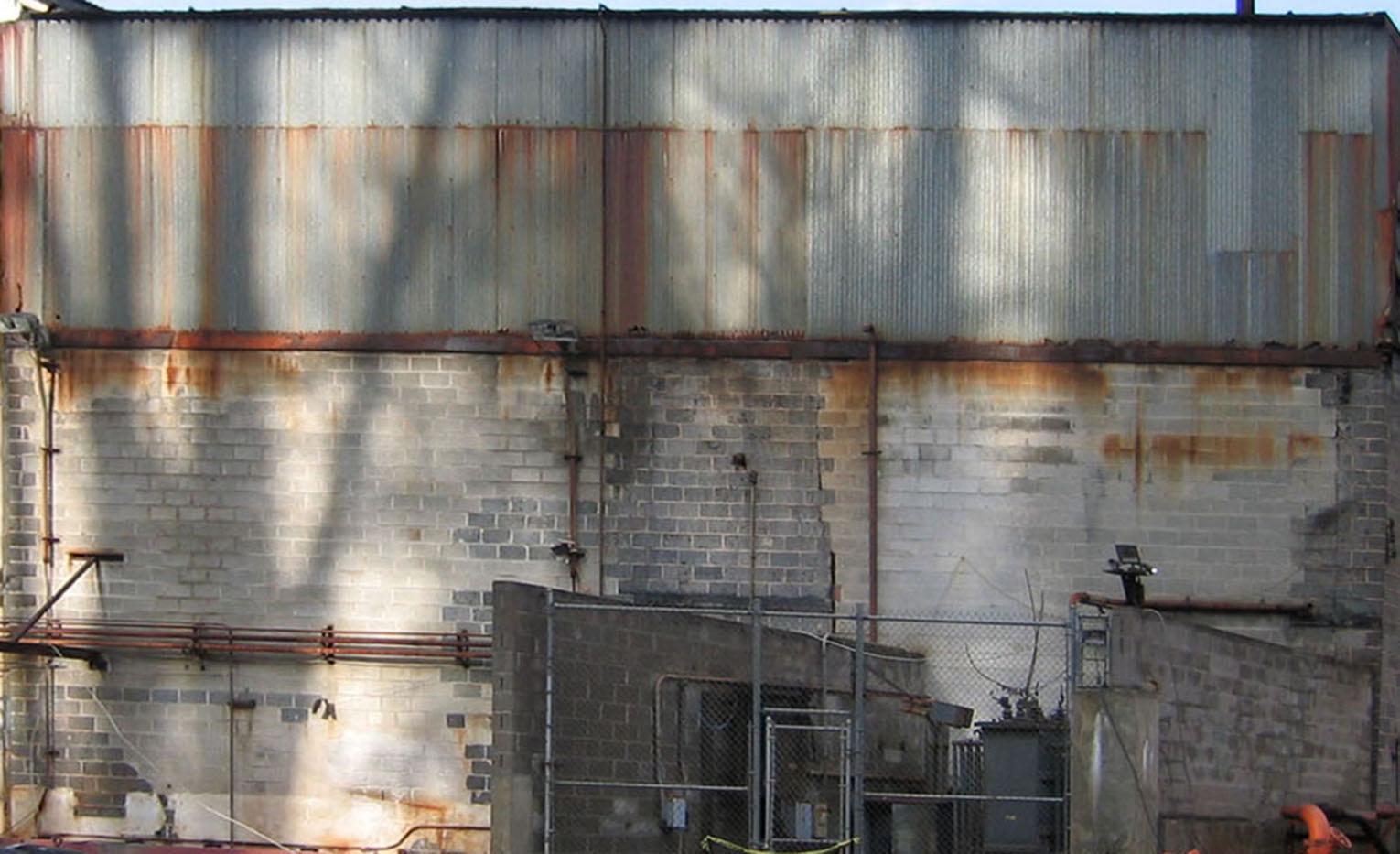
Bartgis Brothers Power Plant, November 2006, John Teichmoeller Photograph.

A new power plant for the newly named Bartgis Brothers Plant was built across the river (on the same side as the railroad) sometime between 1920 and 1940. It was initially coal fired and at some point between 1940 and 1960 three tall coal storage silos were added on the south side, closest to the rail siding. Before the coal silos, it appears the company used the existing company coal trestle along the north side of the right of way and brought coal up the small hill and dumped it on the ground near the building to feed the boilers. Since I can’t nail down a date for the addition of the storage silos and they seem to appear around 1952, I am going to stick with the trestle as the coal delivery method.

Two photos over the course of twenty years show the change, but their dates are too far apart to be exact. One seems to show a truck delivering coal and the trestle seems like a likely source. It seems very labor intensive, but in this time period labor was cheap compared to building more automated delivery systems and this appears to be a temporary solution until the silos were built. Remnants of the trestle exist today and early photos show it in the 1920s. Its construction was covered in an earlier blog.

According to the B&O Officers’ Special Train report published in 1953 Bartgis Brothers received 43 carloads in and 0 carloads out in September 1953. The inbound cars were likely coal for the power plant and pulp for the primary operation. Other reports from the early 1940s indicate they shipped cardboard products to North Carolina and other states supporting the war effort. A B&O memo dated 1944 indicates that the in 1943 the plant received 459 cars of coal and shipped 125 carloads of box board. I assume that as interstate trucking began to develop it took more and more of the outbound freight. Photographs from the late 1960s still show boxcars on the siding, so they may have continued receiving pulp and/or shipped product out be rail.

Ilchester Aerial Photograph, 1940, Smithsonian Institution, National Museum of American History

The rail siding near the steam plant was also used for pulp deliveries at this time. The plant was manufacturing boxes, so pulp was the needed commodity. I am not sure of the source, but this January 1950 Baltimore and Ohio Magazine may show one source from Locust Point. A photo shows bales of Swedish pulp being moved by new equipment designed for the task. The aerial photos show what I believe to be a white fluffy substance near the boxcars which could be broken bales of paper pulp. I can’t be sure without company shipping records, but it is a plausible source, maybe not the only one for the Bartgis Plant’s raw material. I suspect finished product was shipped to local manufacturers, but again, this is supposition.

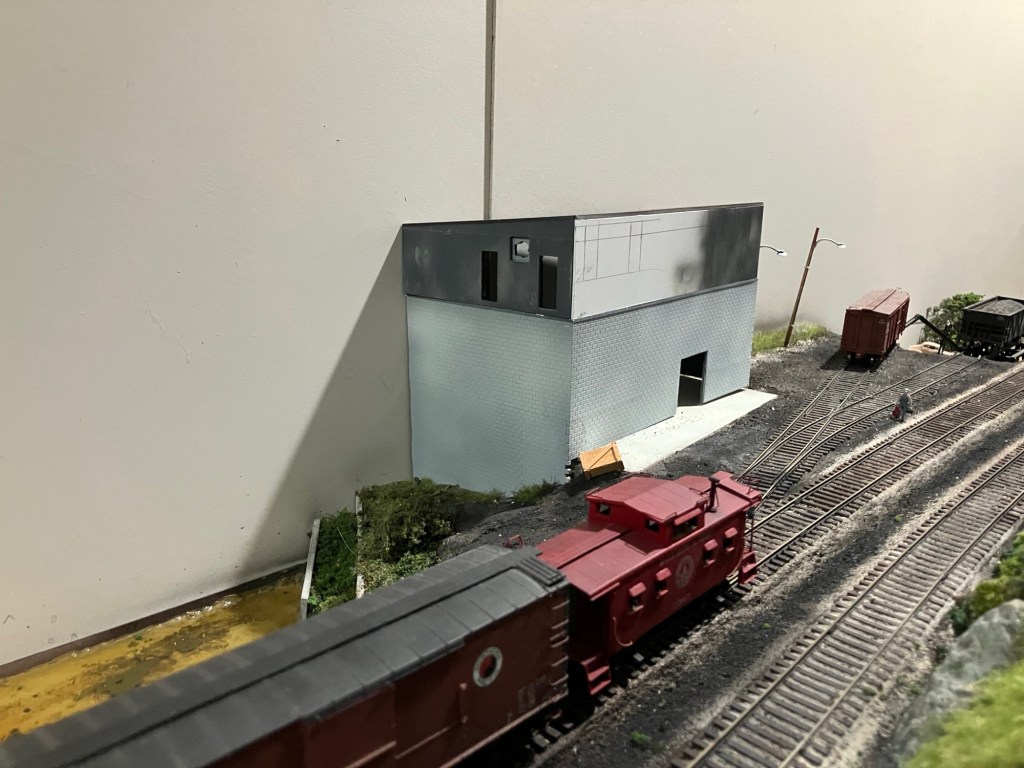
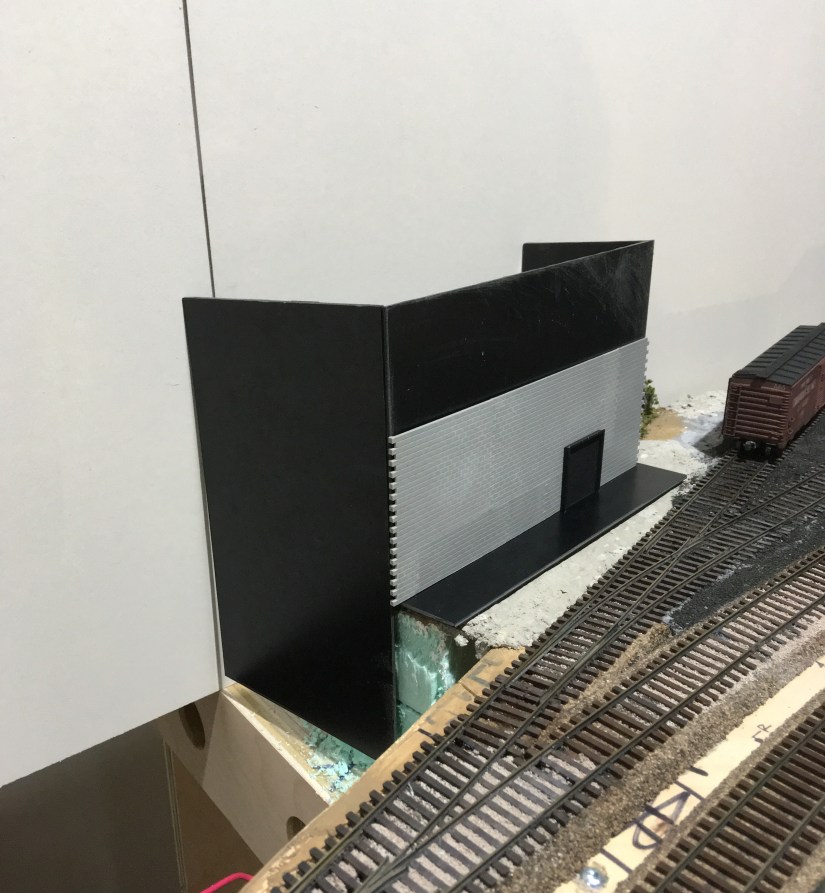
Model in progress.

My model of the power plant started with the modern photo by John Teichmoeller, as the building was gone on my most recent visit in 2018. John’s 2006 photo appears to have an addition on the left that did not appear in period aerial views. Using PhotoShop, I squared John’s photo of the building and cropped it make the first mock-up (photos below). Using the standard 8″x 16″ cinder block size, I was able to get a close approximation of its size. The side of the building facing the track is about 62 ‘x 36’ high.

To replicate the cinder block walls I used Rix Products excellent Pikestuff Concrete Block Walls. I purchased several packs of Long, Intermediate, and Short Sections for less than $4.00 each. The products fit together perfectly and reading the instructions provided a key insight to keeping the joints tight. There is an “X” cast on the back of each section and these should always have the same orientation when joining sections. It is a small detail but it makes the sections fit seamlessly and hide the joints. The height of the wall sections was not tall enough to let me use a single section, so I cut sections along a mortar line and put the cut along the bottom of the wall. Keeping the “X” on the casting to the same side was again a key to smooth joints. The mock-up photo below shows that part of the process. In the in progress photo below, the top group of sections are glued together, the short height bottom one is not. The roll up doors are from the same product line and are scale 10’x 10′ (Pikestuff PKS-1109 Roll-Up Loading Doors). I wanted to use two, but it looks like the prototype only had one.

Photoshopped and Squared Image
Model in Progress.

Using the squared, cropped photo as a guide, I cut the backing for the south facing (closest to siding and mainline) from .080 thick black Evergreen Sheet Styrene (product #9117). This piece was slightly undersized to final dimensions to allow the overlay of the Pikestuff Concrete Block Walls. Since my overall dimensions were estimates, I made the interior support walls to fit the interlocking block pieces for neat joints at the corners. While I was doing this basic framework, I used Evergreen #4037 to simulate the corrugated metal siding on the top half of the structure. For the openings in the structure, I purchased Tichy #8157 18 Pane Top Tilt Out Industrial Windows and PikeStuff 1009 Louvered Ventilators.

The lack of photo documentation gives my some latitude but I am looking for a measure of prototype fidelity, I have put this much time into it already, why stop now.

For the windows I wanted to recreate a hot August day in 1950, so they are open as seen in the aerial photo. The Tichy windows have a top frame that is adjustable so I chose to have it tilt out with a control rod to replicate the industrial windows that tilted out to relief the heat stress from the boiler and the summer temperatures.

Tichy #8157 window with a control arm added to open the “vent” portion of the window.
The HYG Evergreen siding was squared and cut to add the Tichy window frames and the Pike Stuff vents.

The left or west side of the building extends down to the river near two large concrete block retaining walls built to protect it from flood waters. The steam and condensate return lines appear to exit the power plant near its north side below railroad grade. This is would be beyond the backdrop.

While barely visible through the partially open door, I added a huge boiler and large insulated pipes to the interior. They are visible in person if you look!

The roof appears to be pretty standard for the day and appears from aerial photos to the rolled tar paper roofing that I simulated with black construction paper cut into strips and adhered with contact adhesive. I used a black paint pen to simulate the tarred seems.

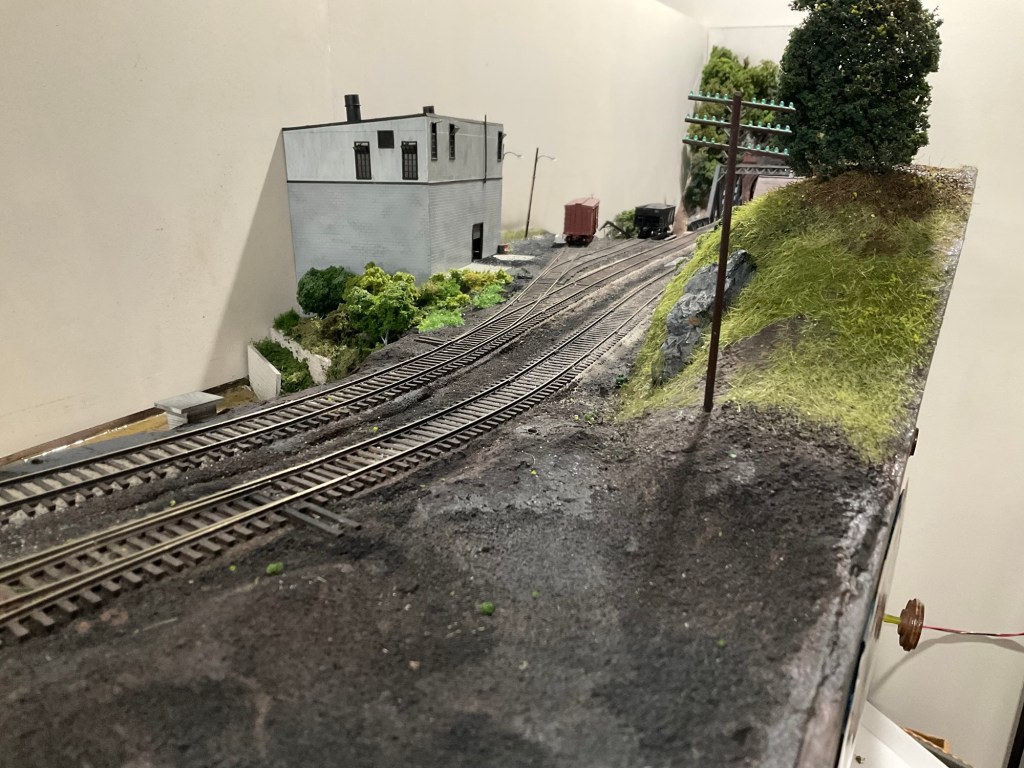
The aerial photo shows the siding that serves the power plant splitting right after leaving the main. The south line (closest to the main) serves the coal dump and looks to serve the main plant also with boxcars spotted railroad west of the coal dump. That north siding also seems to serve the main plant with just boxcars loaded with processed pulp. Trucks must have been used to move material across the river. The siding was pretty short and I modeled it that way so that two boxcars spotted for unloading foul the switch to the coal dump, requiring at least one to be moved to service the dump. A few extra moves for the Peddler crew to make because of the unplanned use of the coal trestle.

Much later photo of the area shows the coal bins built to serve the boiler. Source unknown
Getting near completion, time to add some more vegetation to match the aerial photo.

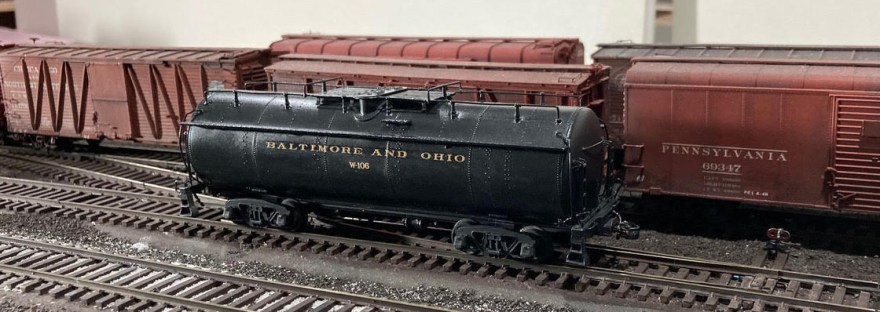
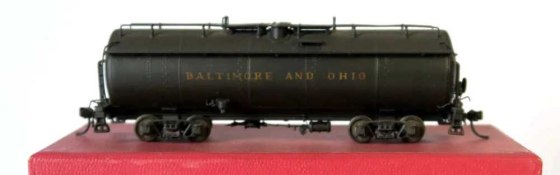
Brass HO Scale B&O Q-4 Mike “Water Bottles”

The more I researched the trains that ran on the Old Main Line (OML) in 1950, the more I realized that the mainline freight trains on the Baltimore Division were almost completely steam-powered during that time. My early assumption was that newer diesel engines carried through freights to Philly through Baltimore from Brunswick, MD. But evidence suggests that the fast freight’s runs from Brunswick through to Philly to were overnight trains with steam at the lead. Mainly Q-4 Mikes, presumably with an extra water tender, called a “Water Bottle” on the B&O.

While I still hope to find evidence of B&O FT units and other early diesels running down the OML in 1950, I am refocusing my engine roster to include more B&O Q-4 class steam locomotives and some water bottles.

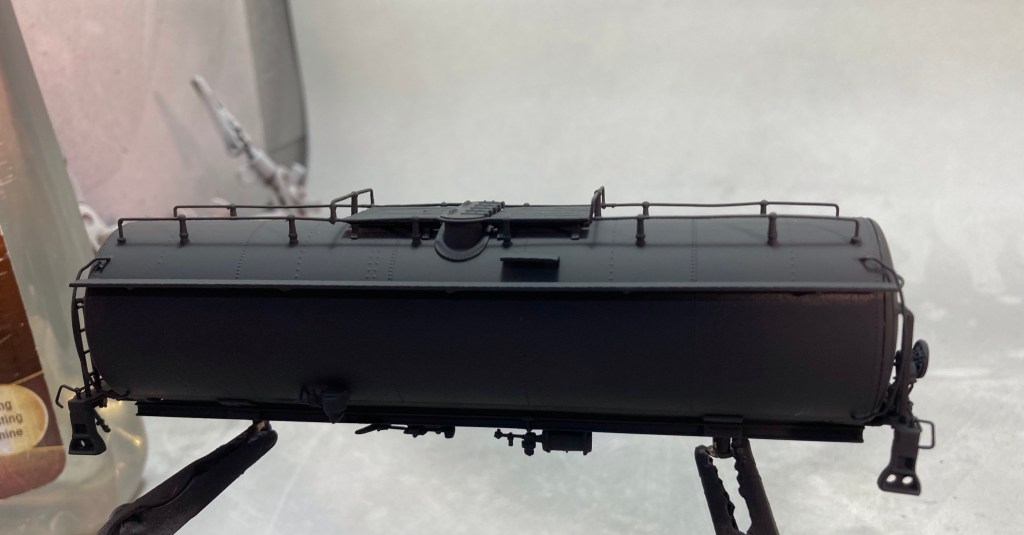
Recently, I found an HO scale Samsonga Water Bottle online for a reasonable price. The trucks were not correct and neither was the lettering. The size of the lettering height was shorter after about 1940 and the trucks were heavier-duty with leaf spring packages.

Original Photo from eBay

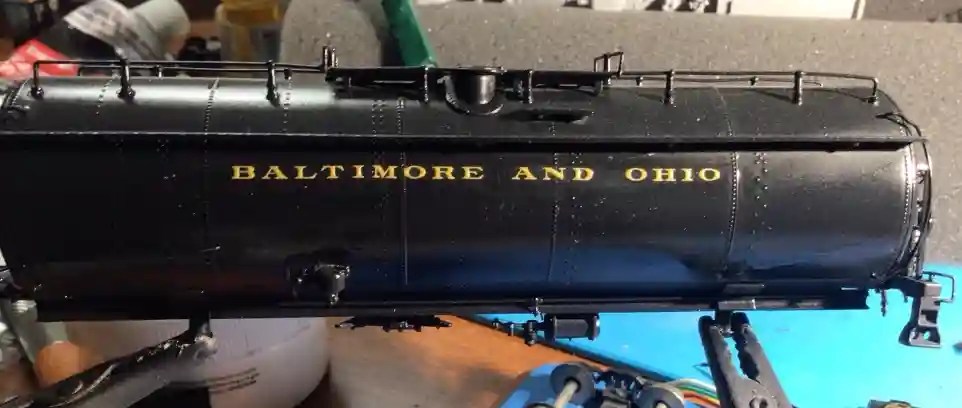
For the correct decals, I relied on B&O S Scale modeler Ed Sauers’ B&O Steam Locomotive decal sheet that includes the lettering for Water Bottles. It is the most accurate available. Ed developed this decal set himself in several scales and he is an excellent source of information about brass modeling in all scales. Ed’s decals can be purchased through another B&O modeler, Bill Hanley at wmhanley at verizon dot net. Send him a message and he can give you purchasing information for the steam locomotive set and several other decals sets that Ed has developed.

And for the correct trucks, I replaced the Kadee Andrews trucks with Precision Scale #31651 Leaf Spring Andrews Trucks. These were a kit, so some drilling of the journals to fit the wheels and soldering of the bolster to the sideframes was required. At least they won’t come loose like some brass trucks that are screwed together.

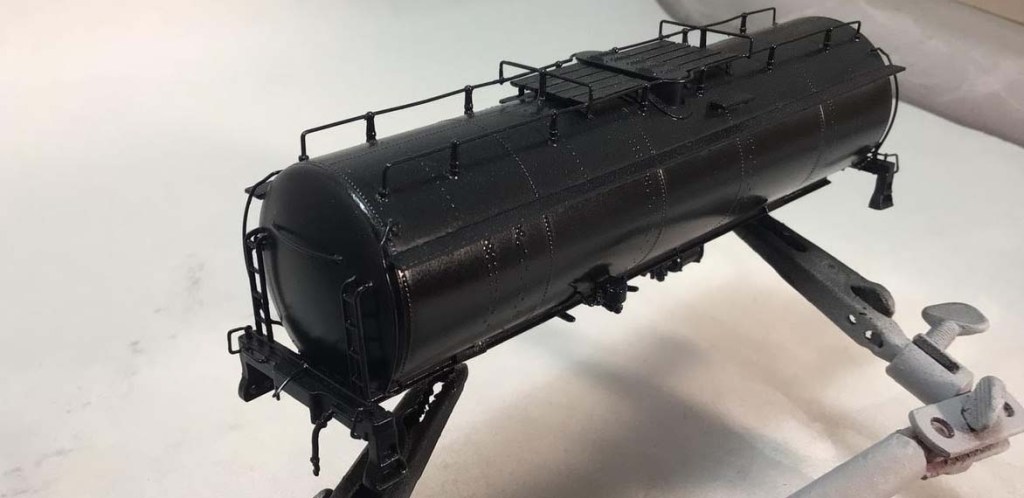
I stripped the black paint and clear lacquer finish from the Water Bottle with ScaleCoat II Wash Away Paint Stripper/Remover for Plastics. I repainted it first with Tamiya Gray Fine Surface Primer L, then Vallejo Model Air 71.251 NATO Black, and finally a coat of “Pledge” clear floor finish for a gloss decaling surface.

Vallejo NATO Black sprayed over the Tamiya fine gray primer.
A coat of “Pledge” to add a gloss finish for decals.
Decals applied to match post war stenciling.

My Q-4 Mikado #4620 will fill in for Q-7f #4844 when it is being serviced and as one of the lead locomotives on fast freight runs from Brunswick to Philiadelphia and back every night and when running late appear early in the morning. In that latter role, it will have this Water Bottle, W-106, added to save water stops in order to meet the tight schedules for the fast frieghts to Philly.

According to the Q Book (Q The Definitive History of the Baltimore and Ohio Railroad Company’s Q-Class Mikado Locomotives by Howard N. Barr and William A. Barringer) Water Bottle W-106 was an “18,500-gallon auxiliary tank converted from (a) Q-4/4b tender.” Its weight fully loaded was 230,000 pounds and it rode on B&O “No. 52A” trucks. I don’t think anyone has found the key to the B&O truck numbering system.

B&O Water Bottle W-106 Brunswick, MD 1947. Carl Gerber photograph.

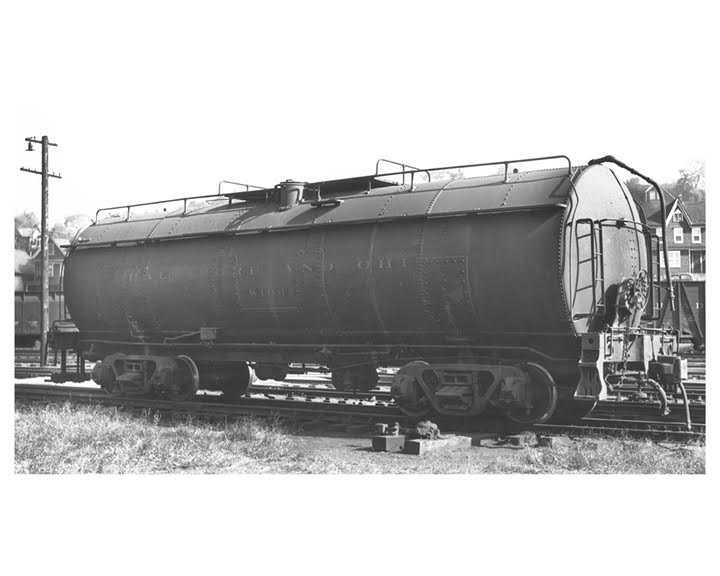
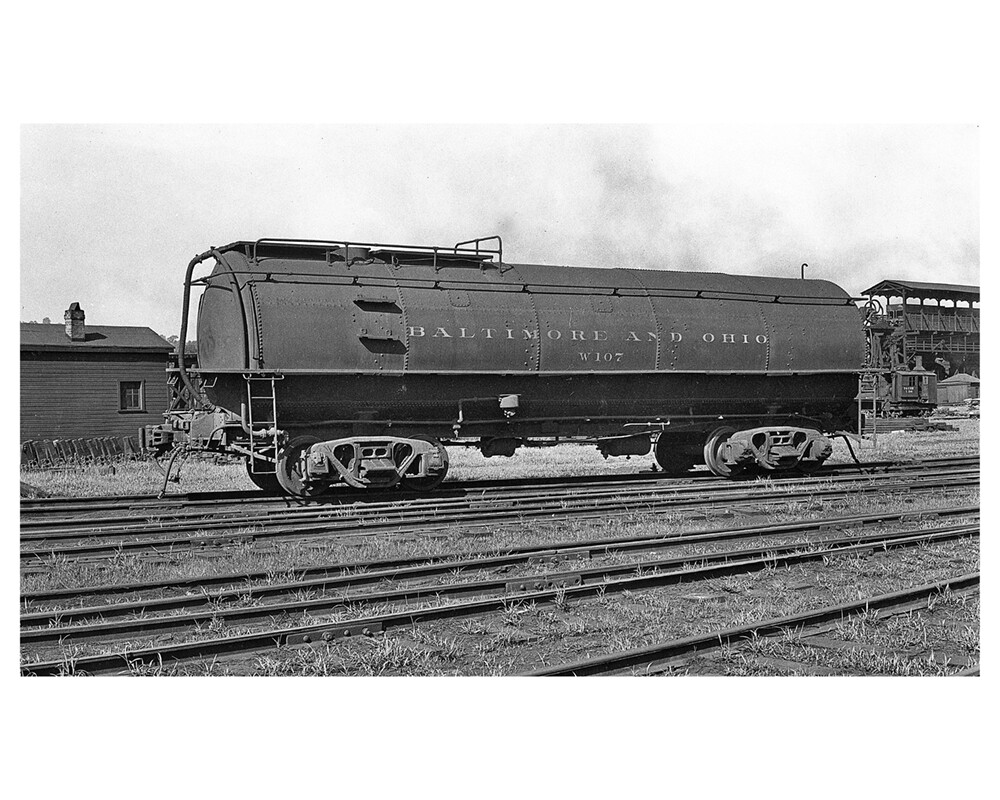
I would certianly like to have a second Water Bottle to run with a second Q-4b that I am working on currently. And I have seen several brass models just like W-106 for sale. The problem is that each Water Bottle seems to have been a unique creation. For example, in the Q Book information about W-107 indicates it was a “16,000 gallon auxiliary tank converted from (sic) S Tender.” And there is no accurate brass model for the W-107 available. This might be an opportunity to scratchbuild one or maybe I should learn CAD better, create a printable file, and have one 3d printed.

B&O Water Bottle W-107 Brunswick, MD 1941. Clifford Scholes collection
On the layout in Brunswick, ready for its next assignment.

I have yet to weather the W-106, I will do it at the same time as I weather the Q-4b it will be paired with for fast freight service. If anyone wants to help out with creating a CAD drawing for the W-107, please contact me through the comments section. Thank you!

Enter your email address to subscribe to this blog and receive notifications of new posts by email.

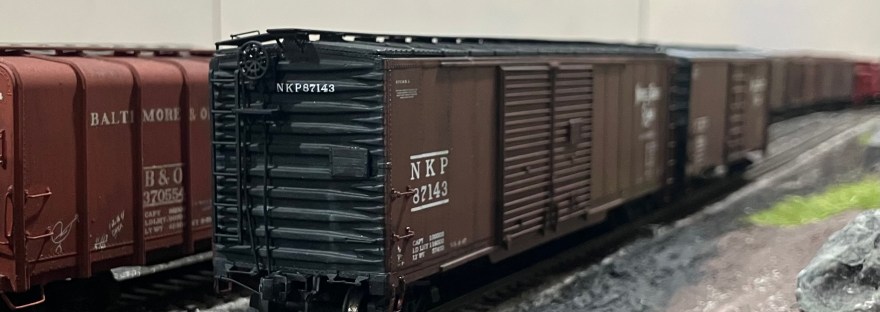
Some Special Freight Cars on My B&O Old Main Line. Thank You Bill Welch.

In the early 2000’s listserves started to take off and I met Bill Welch on a modeling group. I was busy with a young child and was trying to fit in some modeling time. He was retired, a great friend, and supporter. And with Bill’s support and the tremendous help of Al Buchan, I started the B&O Modeler learning from him as he led the way for everyone with the Keystone Modeler.

Bill and I traded information often and I was always trying to support his passion for all things FGEX. While I learned more about the B&O from many folks and especially those guys led by Nick Fry toiling away in an old garage that was the B&O RR HS Archives. Bill always shared his knowledge freely, something that wasn’t typical at the time.

Bill and I had many conversations and at some point I realized he was a retired pastor. Well I don’t think pastors ever retire, they just slow down a little. I count him as a close friend, though we never met in person. We stayed in contact through his last days and I hope I became a better person because of it. Bill was always a good friend, kind, supportive, and helping me see things were possible when I wasn’t sure.

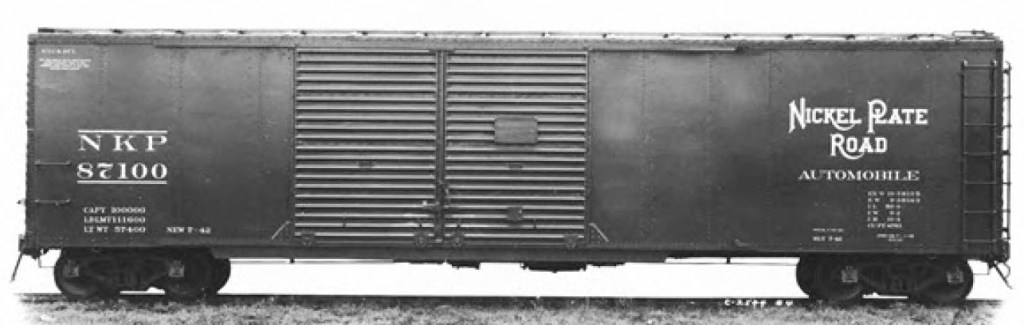
Maybe it was six months ago, one of Bill’s modeling friends was helping settle his estate and a box arrived with three Bill Welch original boxcars.

I was dumbfounded by the opportunity to put some Bill Welsh models on my layout and learn about a charitable cause close to his heart. Every time I look at them I think of Bill and how I can do more to help others. And I don’t mean modeling or trains, but how to be a better me and have more grace.

Bill was a person of grace to me. Not much more I can say.

Enter your email address to subscribe to this blog and receive notifications of new posts by email.

B&O M-24 USRA 40′ Boxcar – Achieving a Color Shift on a Rapido Model

B&O M-24a or b “Cement Car”. Paul Dunn Photograph. B&O RR Historical Society Collection.

This is a quick blog post so that others faced with a similar dilemma can see if they can use my techniques to shift the factory applied paint on their Rapido USRA B&O M-24 boxcar. I have several other blog posts and models I am working on, but this was an unexpected issue that came in the mail with my factory ordered model. I expected a brown boxcar to arrive and when time allowed I would change some lettering to reflect a ten year old boxcar on my layout set in 1950.

When the car arrived along with a Midwestern road version that I was really after to serve my milling plant, I took a few minutes at lunch to add some black and gray pin wash to both cars. The finish was glossy enough that I thought the technique could work straight out of the box, no gloss coat required.

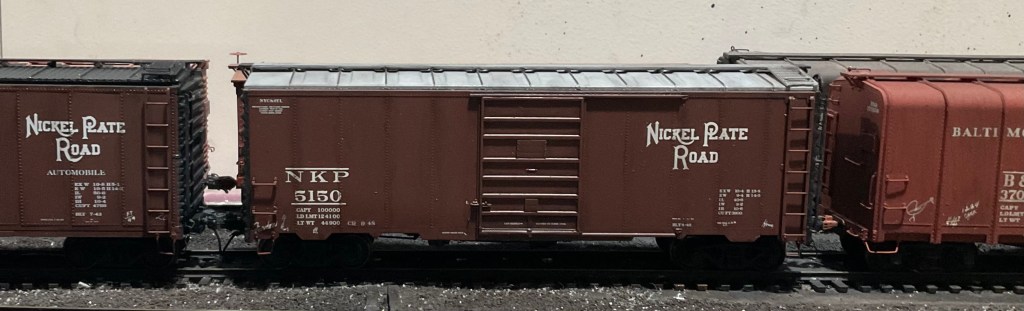
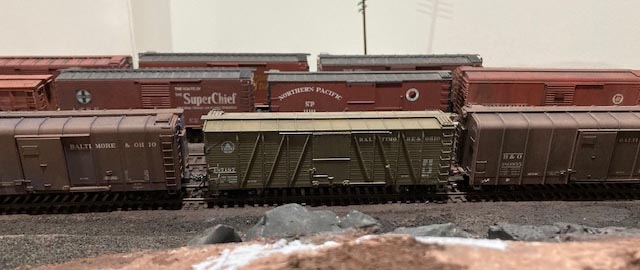
The Rapido model is between two other commercially available B&O freight car brown boxcars that are close to the color seen in prototype photographs from the era. The only alterations to the Rapido car are some black pinwash on the simulated metal parts on the sides and ends. The other cars have been sprayed with a clear matte varnish over black and dark gray pastels. The photo was taken under 5000K LED bulb lighting.
The same model photographed in natural sunlight with the same slight weathering.

The pinwash did work and since I was was working near a large window, I had lots of sunlight to assist. This environment made me look closer at the color of the B&O car and I was convinced it was more green than brown. Sort of an US Olive Drab Green. I took some photos. And then when I got home I put it on the layout next to other boxcars of all kinds and to my surprise it looked even more green. I know lots of people have some type of color blindness so I thought that’s what I was seeing. But it was definitely different and didn’t come close to any of the B&O brown boxcars I own, either commercially painted or those I painted myself. I took some more photos on the layout under 5000K LED bulbs and shared them with a few friends who model the B&O and look at colors critically. They agreed that it was green I was seeing. For context, let me add that B&O boxcars of that era were painted a very average brown color until the mid 40s when a much more red freight car red was introduced. That later color is the color many see in color photographs of 50s era B&O boxcars. These changes in color also go along with changes in lettering. These were detailed by Chris Barkan and this information is available on the B&O Railroad Historical Society website. And to make it more difficult to know a true color there are not too many color photographs of the older brown color.

A relatively unweathered B&O boxcar in a 40’s era Jack Delano photograph. Library of Congress Collection.

I should have stated this up front and it is very important to say. I am not, and I repeat not, someone who focuses on exact color matches and original drift cards in my modeling. But, I do expect that when I purchase a well detailed and accurate prototype model that the color be close to the prototype. I don’t know the correct color for every model I buy and I trust the manufacturer of a high end product to get it close. This was not close by my standards for a B&O boxcar, but it may be fine for many others.

So what to do? I am aware that the manufacturer worked with the BORRHS so I assume they did their due diligence, so I wouldn’t expect a refund or a new model. Things happen. I looked at this as an opportunity to learn a little more about the color wheel and see how I could make this model match the other cars in my B&O car fleet. Many of the other cars in my fleet are Rapido, so this is not an indictment of their efforts. I certainly appreciate all the steam era models they have brought to the marketplace and support their efforts as much as I can.

So learning a little more about the color wheel and using techniques shared with me on the Real Steam Freight Cars .IO group, I decided to try to tint a matte overspray with a color that would shift the color of the car closer to what I believe is appropriate for a B&O boxcar painted in the late 30s or early 40s. I assumed this era based on the stenciling recreated on the model. As I detailed in a previous blog post, I now use Winsor and Newton Galeria Matt Varnish (I switched from Dullcote for performance and economic reasons, see previous blog), which is water soluble and can mix with the Vallejo Model Air colors that I choose to use.

I loaded some Matt Varnish in my airbrush and added a few drops of Vallejo Fire Red and less German Red Brown (about 5 to 1). I sprayed it on some white paper to see how much red brown would be applied to the model. I chose a red brown mix as that is opposite green (blue and yellow mixed) on the color wheel and should mute out some of the green in the boxcar’s appearance. It took two coats and the overspray turned the white lettering pink, there was a fair amount of red in the tinted matte varnish.

It might not have been the best solution, but I was trying to save myself from having to repaint and decal the model, so I used a microbrush to quickly wipe off some of the overspray from the lettering while it was still wet. It worked for the most part, but up close (last photo in this post) you can see where the overspray was wiped off of the car body outside of the lettering. Hopefully it’s not too noticeable, but it did cause me to go a little heavy on the weathering. Not inappropriate for a ten year car, I hope.

The result of the tinted matte overspray next to a more weathered model shown in the previous photo. This photo is also taken under the same 5000K LED bulbs I use on my layout.
These are the colors I used to tint the matte varnish. The Fire Red was added about 5 drops to 1 drop of the German Red Brown to the paint cup of Matt Varnish.

I added some paint failure spots on the roof with gray paint, blue washes and assorted colored pencils, then weathered it with black pastels to simulate soot and a hard life in the Northeast. The sides were lightly sprayed with a gray/black tinted matt varnish to add some lighter weathering to look softer, but similar to the roof.

The last details I add were new decaled reweigh and repack stencils closer to 1950, some faded chalk marks with sharp colored pencils, and a couple of brighter chalk marks with decals. I added spots of Pledge for a gloss decaling surface where needed for decaling, then after heavy doses of Walters Solvaset, covered the decal spots with matt varnish and some gray chalks to fade them a little. The trucks and wheels were sprayed with Vallejo NATO Black like most cars on my layout. The couplers were replaced with Kadee #158 scale head couplers. I still need to add some rust paint to them.

I hope this provides some helpful information to others and allows them to rescue this model or others using similar techniques. I certainly wasn’t expecting or relishing this challenge, but in the end I learned some new things and ended up with a model that fits my layout well. That’s got to be worth something!

This is the finished model on my layout. The color is very close to the brown freight color I would expect.The model depicts a car painted in the late 30s or early 40s as it might appear in 1950 without a repaint.
And here is a roster shot of the finished model in higher resolution.

Enter your email address to subscribe to this blog and receive notifications of new posts by email.

A Paint Booth for Acrylic Paints

A Nice Place to Paint Freight Cars

I have written before about my switch to acrylic paints, specifically Vallejo paints for airbrushing. To keep down the mess in the house, I wanted a cheap, lightweight spray booth with lots of light and an exhaust system for the particles and slight odor. I have been airbrushing inside with a cardboard box and using a respirator to catch particles before the entered my body. It had its limitations.

The Old Cardboard Box Solution.

I started with the idea of using a plastic storage crate about the size of my cardboard box. The plastic was hard to work with as it was brittle and my search for an inline exhaust fan didn’t work out. I was hoping the clear plastic could help with lighting inside the booth, be lightweight, and portable for future moves.

The Original Paint Booth in a Storage Crate Idea.

I live on top of a large granite and marble deposit, one of the revenue sources for the NCR that run through this area starting back in the 1830s. These deposits off-gas low level radiation, so my house is fitted with a radon removal system. It is basically a hole in the basement slab with an extraction fan outside of the house to pull the radiation up and away from the house. When I first moved in seven years ago, the exhaust fan on the side of the house wasn’t working, so I found the same fan model and replaced it. Just last month the fan started to vibrate, maybe a bearing was wearing, and it caused a reverberation throughout the house. A new fan was sourced for about $150 and the replacement (a new model number with slight design changes) ended the house-wide vibrations. Then I realized I had a fan that could pull 160+ cfm that works, but with a slight vibration. Paint booth dreams were again alive. And one big advantage is this fan is that it is meant to connect with 4″ PVC pipe and easily adapted to use flexible, metal 4″ dryer hose connections.

The main lesson that I can share from this experience is that lightweight construction is possible on a budget. A little time woodworking with a table saw can provide a strong frame and the walls can be thin and lightweight. Like the walls on the inside of a house, the framing provides the structure and the skin can be weak. Having enjoyed the size of my cardboard box, I used it for a start and created the main structural members from 3/4″x 2″ poplar. You can use another wood, but I was lucky to have access to some hardwood stocks that a friend was willing to share. I created two 18″x !8″ frames for the sides and used half-lap joints with glue, then a light spray to polyurethane to seal the wood. A glued half-lap joint is very strong and provides the main structure for the booth. The width between the two sides was determined by the width of a roll of easel paper. I saw this online, someone used a roll of drawing paper hung at the top, back of their paint booth to allow for a renewable white background for painting and possibly photography. The rolls are available through Amazon and much cheaper at many craft stores for $6, they are used for children’s art easels.

Gluing Half-Lap Joints on Side frames.
A Light Coat of Polyurethane on the Side Frames.

For the bottom of the box I used a thin piece of plywood lying around in the garage. It was 1/4″ pine, which helped with keeping the box light. I added a second piece of 1/4″ under the front lip for dimensional stability. My second choice was a piece of 1/2″ birch plywood left over from layout framing. The width was 20″ to allow for the paper roll to fit within the side frames. The depth was set at 22 1/2″ to give me a little lip on the front of the box for paint bottles, cleaning supplies, and the spray-out pot I use to clear my airbrush. The side frames were screwed from the bottom of the plywood base. I skipped glue here in case I want to take it apart or adjust the size. The added a lip also gave a place for the paper roll to be slid under and secured.

The Paper Slides Under the Lip.

I wanted the top to be clear or translucent to allow light to enter the box and possibly add lighting from outside the box. I was leaning toward buying some plexiglas to cover the 20″x 18″ top of the box. I didn’t need a solid piece of plywood like the bottom foundation, so I was thinking of just using some 20″ wide scrap strip to the keep the sides from moving too much with the plastic to fill the space. Once again a scrap piece of material came to mind. I had several 12″x 12″ pieces of glass from former wall decorations that I had saved to use for my modeling bench as replaceable smooth work surfaces. A couple of pieces of the poplar hardwood I received had reliefs cut into them so two 18″ pieces became the top braces, along with another scrap piece for the back edge. I was going to screw the glass in place as the pieces had holes in the corners, but I decided to use two more pieces of the same trim to capture them in place within a frame, a few thin screws helped hold this together and make it removable should the glass become to covered in overspray.

Top Frame and Light Opening.

For lighting I am using a simple metal, portable flood light sitting on top of the glass and two short screws into the cross braces to keep it from moving and stay above the glass. The light fixture is fitted with a 5000k LED floodlight bulb which operates cool to the touch and is the same bulb used over my layout. Do not try this with an incandescent bulb, they are way too hot and a possible fire hazard being in contact with cardboard and finished wood! The 5000k bulb should help with having the paint applied in the booth look the same as it would on the layout.
LED Light Fixture in Place.

A simple dowel was used to hang the roll snugly between the sides. I mounted it as high and as far back in the box as possible. The roll I bought is 75′ long so I need to remember to buy the same size in a few years as I have seen much longer rolls with larger diameters available. The cardboard used for the back wall is visible.

Adding white cardboard or foam-core is just the covering for the back and the sides, it provides no structure, but keeps the negative pressure pulling air from the front of the booth (where is protects the user) and white allows for better light reflection inside the box and thus more light on the paint subject. It is just stapled in place so that it is easy to replace. We’ll see how this works over time.

The radon fan needed a mount as in its primary use it is attached to braced 4″ PVC pipe with rubber collars on the outside of the house. (insert photo of fan outside house). Here again I took advantage of scrap lumber, this time a 24″x 24″ piece of birch 1/2″ plywood left over from my layout’s modular structure construction. I built a shelf 10″x 10″ to be as wide as the fan and used a jigsaw to cut a 5″ hole in the center to allow the fan body to sit down into the shelf. To mount the shelf to the cinder block wall of my basement I cut a mounting bracket with a dado cut to fit the shelf and then added some angles from the shelf down to the bottom of the mounting bracket. I gave this a light spray of polyurethane to give it some dimensionally stability over time. After attaching the mounting bracket to the wall with three Tapcon concrete screws, I added a couple of drops of acrylic adhesive caulk to attach the fan housing to the bracket and keep it from moving around, while providing a soft mount to keep vibrations to a minimum. I only used a couple of drops of adhesive as I want to be able to cut the fan free should it fail in service.

The Assembled Parts of the Radon Fan Shelf and Mounting Bracket.

Venting the booth outside house is always a challenge. A window can be a great option. I didn’t have this option in the unfinished side of my basement. Then I caught a lucky break that not one in a million modelers gets, I found an unused dryer vent to the outside just seven feet from my intended booth location. It still goes outside and was plugged with expanding foam to keep out small animals. I can’t figure out why it is there, the washer-dryer is fifteen away and there are no nearby plumbing connections to suggest the washer-dryer had been moved at any point. I can’t help you if you are not that fortunate, but I can say the radon fan will push some air as it is sized to move a lot of air two stories up, so a longer run on the exhaust side of the fan is practical. Keep in mind this is only for use with non-flammable solvent paints and finishes, don’t try this with flammable solvent based paints!!! If it doesn’t clean up with water, I don’t use it.

A Fortunate Dryer Vent.

This is a design-build project, so I had a general sketch or two in place and set out to build it to meet the design intent with the materials on hand, adjusting as needed. And I am writing this blog as I am building it, so one of the last details to complete was how to connect the duct work to the side of the box. In the original plastic storage crate design I was going to use a 14″x 14″ filter in front of the fan connection at the back. I realized a side mount fan would be better for my new box design and allow the booth to sit closer to the wall and more out of the way. I knew this wasn’t a good a design to get the best laminar flow across the face of the paint booth, but with 160 cfm pulling through the fan, I was going to exchange all of the air in the box about once every two seconds. Adequate air flow shouldn’t be a problem. The plan was to put a 4″ coupling for flex duct on the top edge, near the back of the side nearest the fan and use some type of filter to protect the fan from paint particles. So far I have only invested time, as all the materials were on hand. I grabbed the 14″x 14″ inch furnace filter to see how I could attach it to a side frame or maybe consider something else. Serendipity struck again and the filter fits perfectly into the popular side frame opening. It was a press fit! I would like to say that was planned, but it was per luck. With the fan pulling through one corner of the filter, I actually think I can get four times the filter life as I will rotate it periodically to put a fresh corner of the filter closest to the fan intake. So next I attached a coupling connection to a 5″x 5″ piece of the 1/4″ plywood with a 4″ hole and…

Furnace Filter Press Fits into Right Side Frame

The finished box, now a paint booth, needed to be attached to the wall and/or held up on legs. I wanted the booth at layout height so I was painting models at the height they would be viewed. I decided to use some plastic shelves from Lowes that are 18″ wide. I attached them to the wall with 1-1/2″ conduit clips to keep it in place. It was a little top heavy. The $20 shelves gave me a place for paint and thinners. A nice bonus.

I connected the flex dryer hose to the connector and hit a few gaps with duct tape for some and caulk for permanent connections. I may add a piece of plexiglas across top front to increase air movement through the box. It pull the fumes away, but you can never have too much ventilation.

Duct Connection, Cardboard Sides, and Conduit Straps Holding it All in Place.

This was a fun project and added a little professional touch to my modeling. It doesn’t hurt to have nice tools and this one was low cost. Model on ya’ll.

Enter your email address to subscribe to this blog and receive notifications of new posts by email.