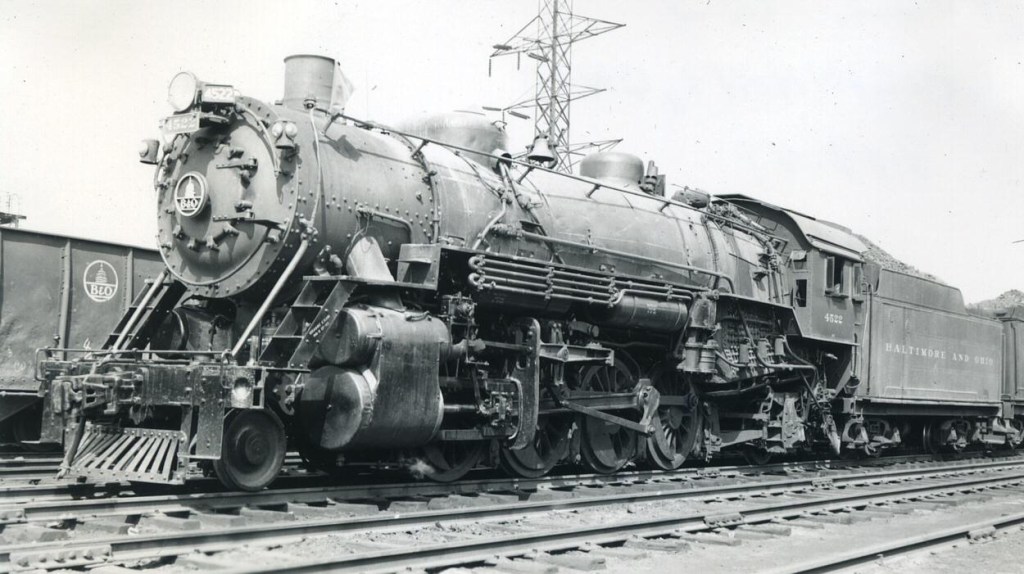
The more I researched the trains that ran on the Old Main Line (OML) in 1950, the more I realized that the mainline freight trains on the Baltimore Division were almost completely steam-powered during that time. My early assumption was that newer diesel engines carried through freights to Philly through Baltimore from Brunswick, MD. But evidence suggests that the fast freight’s runs from Brunswick through to Philly to were overnight trains with steam at the lead. Mainly Q-4 Mikes, presumably with an extra water tender, called a “Water Bottle” on the B&O.
While I still hope to find evidence of B&O FT units and other early diesels running down the OML in 1950, I am refocusing my engine roster to include more B&O Q-4 class steam locomotives and some water bottles.
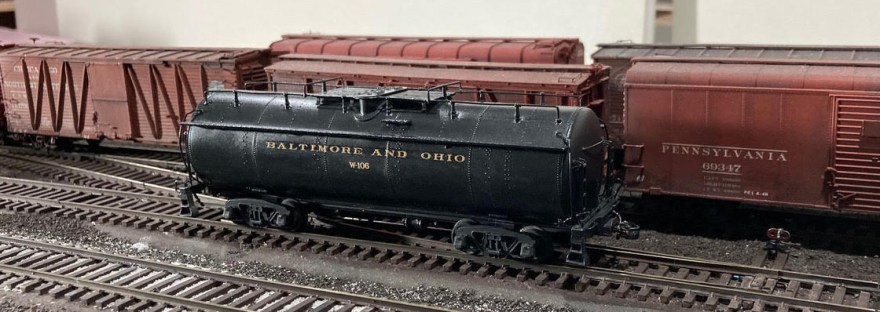
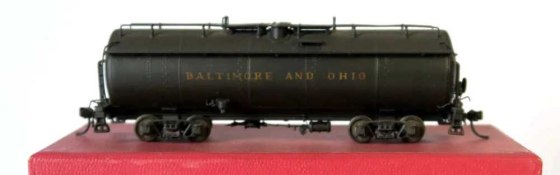
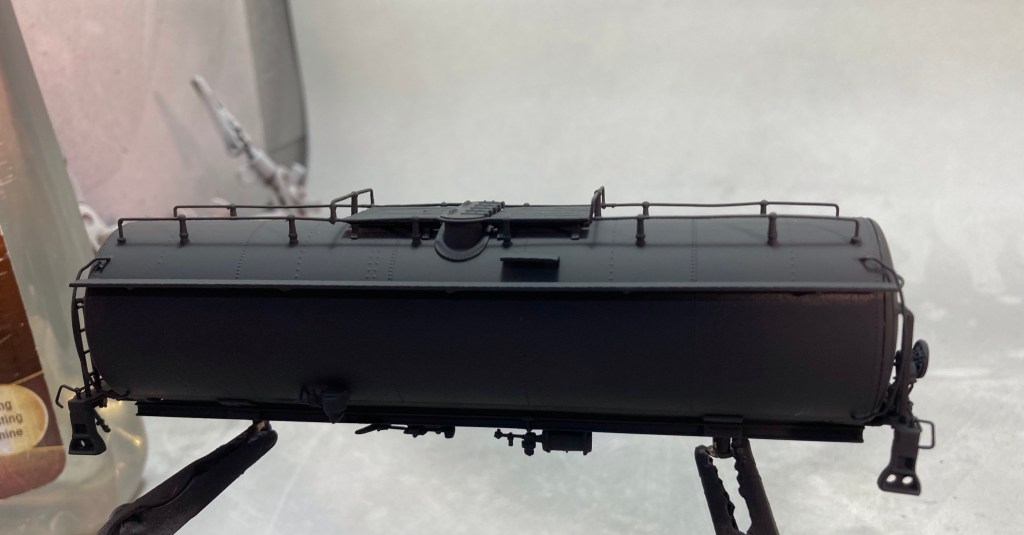
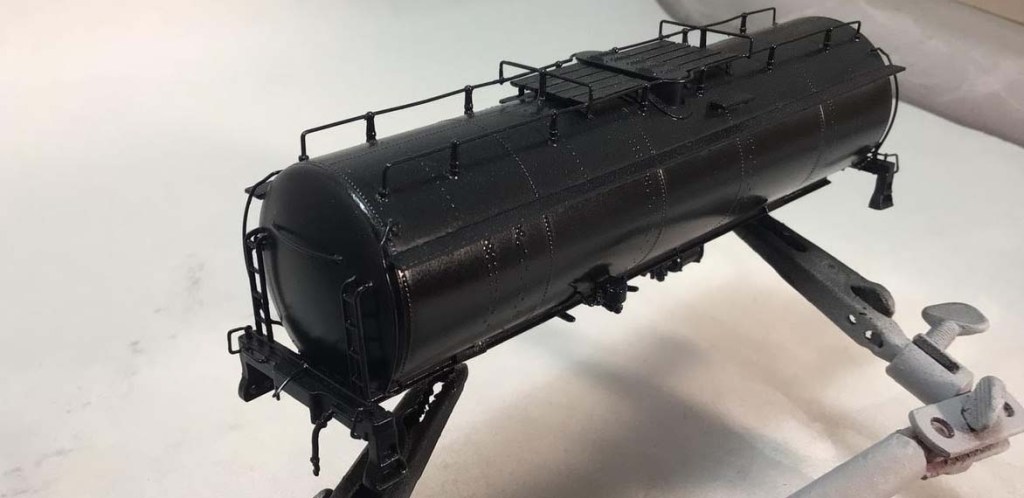
Recently, I found an HO scale Samsonga Water Bottle online for a reasonable price. The trucks were not correct and neither was the lettering. The size of the lettering height was shorter after about 1940 and the trucks were heavier-duty with leaf spring packages.
Original Photo from eBay
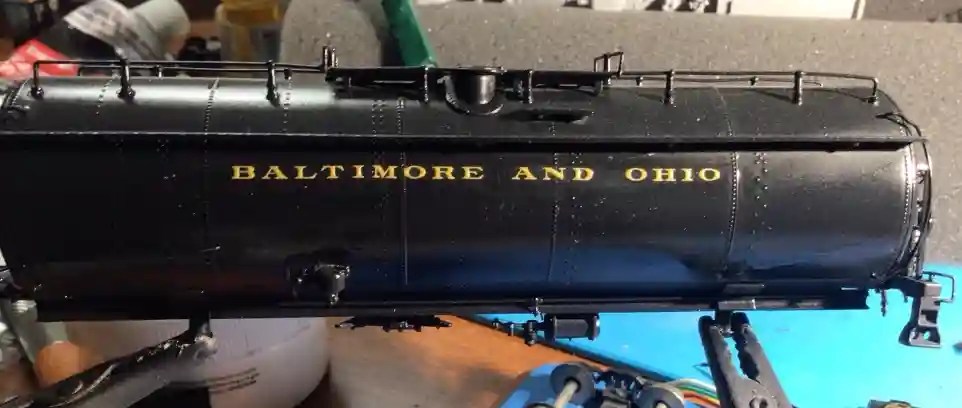
For the correct decals, I relied on B&O S Scale modeler Ed Sauers’ B&O Steam Locomotive decal sheet that includes the lettering for Water Bottles. It is the most accurate available. Ed developed this decal set himself in several scales and he is an excellent source of information about brass modeling in all scales. Ed’s decals can be purchased through another B&O modeler, Bill Hanley at wmhanley at verizon dot net. Send him a message and he can give you purchasing information for the steam locomotive set and several other decals sets that Ed has developed.
And for the correct trucks, I replaced the Kadee Andrews trucks with Precision Scale #31651 Leaf Spring Andrews Trucks. These were a kit, so some drilling of the journals to fit the wheels and soldering of the bolster to the sideframes was required. At least they won’t come loose like some brass trucks that are screwed together.
I stripped the black paint and clear lacquer finish from the Water Bottle with ScaleCoat II Wash Away Paint Stripper/Remover for Plastics. I repainted it first with Tamiya Gray Fine Surface Primer L, then Vallejo Model Air 71.251 NATO Black, and finally a coat of “Pledge” clear floor finish for a gloss decaling surface.
Vallejo NATO Black sprayed over the Tamiya fine gray primer.
A coat of “Pledge” to add a gloss finish for decals.
Decals applied to match post war stenciling.
My Q-4 Mikado #4620 will fill in for Q-7f #4844 when it is being serviced and as one of the lead locomotives on fast freight runs from Brunswick to Philiadelphia and back every night and when running late appear early in the morning. In that latter role, it will have this Water Bottle, W-106, added to save water stops in order to meet the tight schedules for the fast frieghts to Philly.
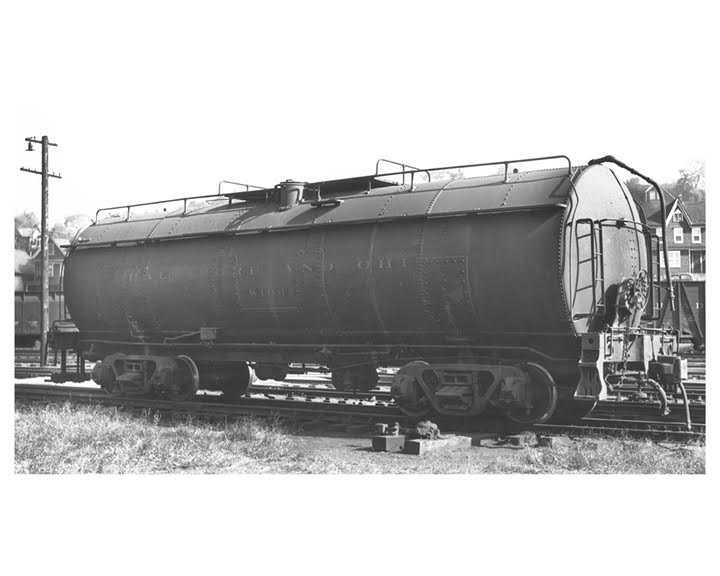
According to the Q Book (Q The Definitive History of the Baltimore and Ohio Railroad Company’s Q-Class Mikado Locomotives by Howard N. Barr and William A. Barringer) Water Bottle W-106 was an “18,500-gallon auxiliary tank converted from (a) Q-4/4b tender.” Its weight fully loaded was 230,000 pounds and it rode on B&O “No. 52A” trucks. I don’t think anyone has found the key to the B&O truck numbering system.
B&O Water Bottle W-106 Brunswick, MD 1947. Carl Gerber photograph.
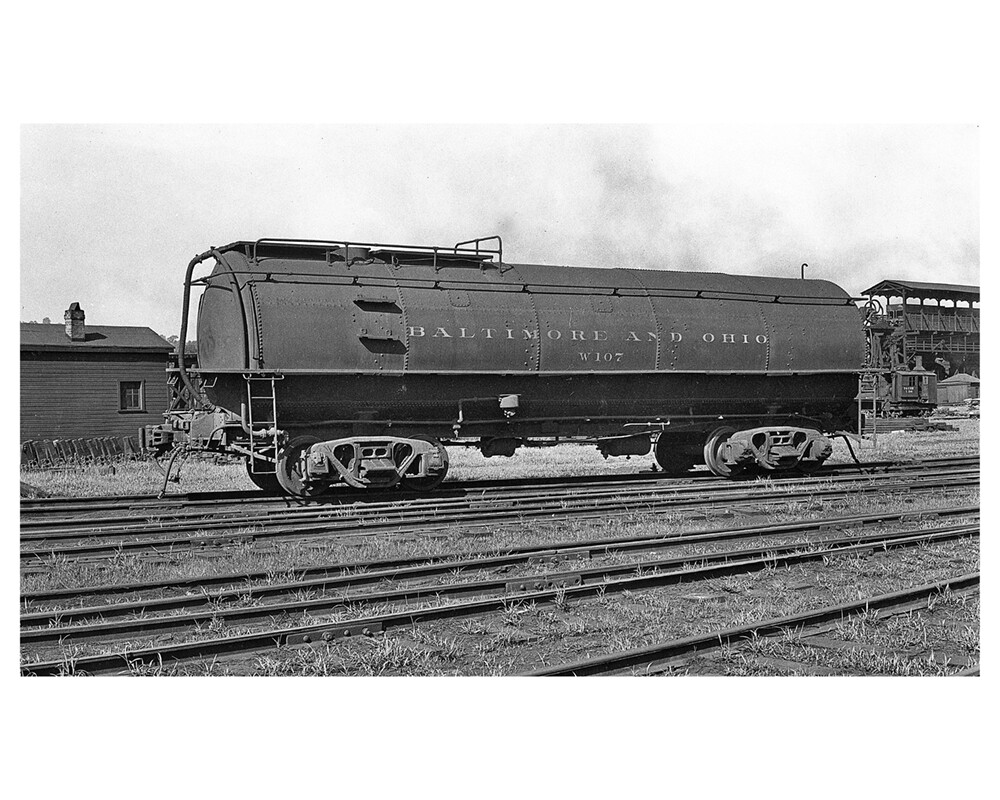
I would certianly like to have a second Water Bottle to run with a second Q-4b that I am working on currently. And I have seen several brass models just like W-106 for sale. The problem is that each Water Bottle seems to have been a unique creation. For example, in the Q Book information about W-107 indicates it was a “16,000 gallon auxiliary tank converted from (sic) S Tender.” And there is no accurate brass model for the W-107 available. This might be an opportunity to scratchbuild one or maybe I should learn CAD better, create a printable file, and have one 3d printed.
B&O Water Bottle W-107 Brunswick, MD 1941. Clifford Scholes collection
On the layout in Brunswick, ready for its next assignment.
I have yet to weather the W-106, I will do it at the same time as I weather the Q-4b it will be paired with for fast freight service. If anyone wants to help out with creating a CAD drawing for the W-107, please contact me through the comments section. Thank you!
In the early 2000’s listserves started to take off and I met Bill Welch on a modeling group. I was busy with a young child and was trying to fit in some modeling time. He was retired, a great friend, and supporter. And with Bill’s support and the tremendous help of Al Buchan, I started the B&O Modeler learning from him as he led the way for everyone with the Keystone Modeler.
Bill and I traded information often and I was always trying to support his passion for all things FGEX. While I learned more about the B&O from many folks and especially those guys led by Nick Fry toiling away in an old garage that was the B&O RR HS Archives. Bill always shared his knowledge freely, something that wasn’t typical at the time.
Bill and I had many conversations and at some point I realized he was a retired pastor. Well I don’t think pastors ever retire, they just slow down a little. I count him as a close friend, though we never met in person. We stayed in contact through his last days and I hope I became a better person because of it. Bill was always a good friend, kind, supportive, and helping me see things were possible when I wasn’t sure.
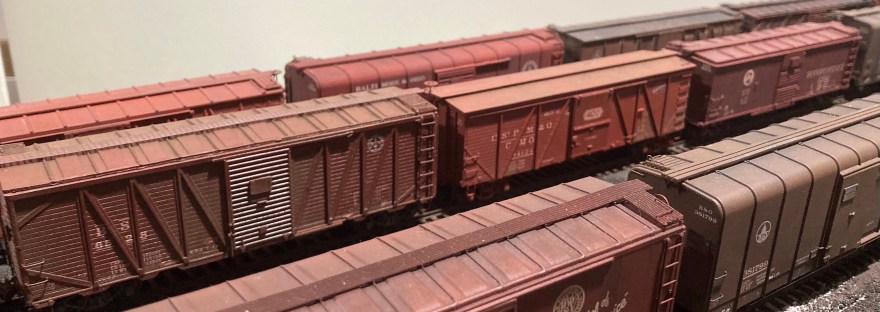
Maybe it was six months ago, one of Bill’s modeling friends was helping settle his estate and a box arrived with three Bill Welch original boxcars.
I was dumbfounded by the opportunity to put some Bill Welsh models on my layout and learn about a charitable cause close to his heart. Every time I look at them I think of Bill and how I can do more to help others. And I don’t mean modeling or trains, but how to be a better me and have more grace.
Bill was a person of grace to me. Not much more I can say.
Some parts of the B&O Old Main Line (OML) remain and remind us that this was not always a shortcut to Baltimore from the west. It was built as a permanent structure to move freight from the middle of the country to its ports in its first 50 years of existence.
My layout is set in August of 1950 and I am trying hard to duplicate the look of that era. Cinders abounded and spread out along the right of way and there was an effort to catch up on deferred maintenance from the Second World War, which took its toll on the right of way. And even by 1950 the OML was still recovering.
On my first “TOMA module” of the Old Main Line, scenery shapes were formed with one and two inch insulating foam cut with a handheld drywall saw to create rough shapes. Messy, and I had to keep a shop-vac handy. I covered them with a Scluptomold mix, now often described as “Scenery Goop”. Not that I have anything to do with its current widespread use, but I have been using this since I was 12 years old. The owner of my local hobby shop recommended it for model armor dioramas and I thought it would be useful for model railroad scenery. At the time plaster and zip texturing was the conventional wisdom for layout scenery.
West Tunnel Portal of Ilchester Tunnel. More trees need to be added over the portal to complete the scene.
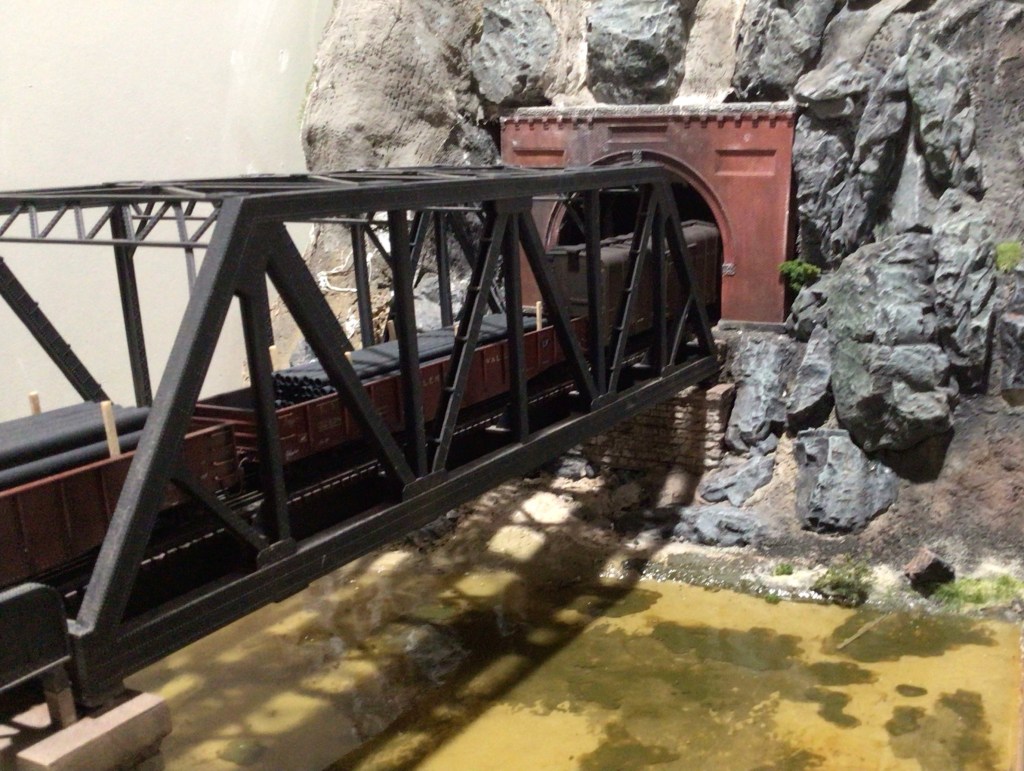
The tunnel portal on this first module has the classic or cliche train layout look of protruding rocks surrounding a tunnel opening. In this case it is the prototype. The Patapsco River flows east to the Baltimore harbor and hits this granite hill, then turns south, and goes around it leaving exposed rock and barely enough soil to support some trees. The railroad followed the river until early 1900s realignment and a tunnel was bored through the hill. To model this steep cliff face I used a variety of Woodland Scenics molds to cast sharp rock outcroppings to simulate the location. They were covered with black paint for a background, drybushed with light grey for highlight, then lightly over sprayed with a light green to simulate the moss that grows on them in the damp valleys of the US Piedmont. I tried to place them similar to the prototype and filled the area in between with goop, Woodland Scenics clumps, and parts of Scenery Express trees were added to simulate the trees that struggle to exist on rocky outcroppings.
The tunnel portal is a very accurate commercial product by Monroe Products (#151 Tunnel Portal Brick B&O style, Double Track) that replicates the brick tunnel portals the B&O used at multiple locations along the Old Main Line. It is a hydrocal casting that I stained with box store acrylic paints thinned with isopropyl alcohol.
The tunnel portal casting. Ilchester Road, the Buick is headed north in the photo under the RR bridge. The Station and Freight House are to the left and the tunnel to the right. The bridge and tunnel are still there in 2023. The station and freight house are gone.
Ilchester Road appears to still have been a dusty, dirt road in 1950. I modeled it with light colored grout to match period photos and the unpaved areas that still exist in the area of the bridge. I added a thin layer of grout then treated it like ballast, with a covering of thinned water and white glue. I added tire tracks to the underlaying layer of sculptamold. The trees are actually curved away from the tracks as the cinders and debris would have kept them from growing too much closer to the tracks. They are Scenic Express trees I coated with various shades of medium and light greens to replicate trees that are still growing, near the end of a a hot, humid summer in Maryland. Late July and August have always meant 90 degree plus temps with 80% to 90% humidity and afternoon thunderstorms. Not great for some humans, but another growth season for vegetation. Having spent some winters in Pittsburgh when the B&O transferred my Dad, I alway love July and August for its hot weather.
Vegetation along the right of way is something I get to study almost every day. I live about 15 miles from the B&O’s Old Main Line and much closer to the PRR’s old Northern Central Railway line. They were constructed within a few years of each other, each following a river. One is still an active rail line, the other is a rail trail that starts 600 feet from my house. I try to walk 3 miles every day and I often ride my bicycle on the trail much further. Having worked on and more recently walked portions of the Old Main Line, I can attest that the vegetation is very similar.
Ilchester Station looking east. Circa 1945. Photographer Unknown.
The steep bank to the right in the prototype photo above looks like it is covered with Woodlands Scenics ground foam. I see this everyday on the NCR Trail. It seems like a cop out to not use some new technique for scenery, but ground foam with some variations in size and color, along with some smaller trees actually seems to replicate this right of way well. Like the NCR right of way, the OML has large granite outcroppings. The are dark grey with lighter edges and often tinted green with moss and other organic coverings.
Looking east on the Old Main Line toward Ilchester station on the layout.
Ballast is another topic that is best covered in a brief way. When you’re a trackman on the railroad, ballast is part of the job. You learn how to make sure it is solid and on production gangs with big, mechanical ballast tamping machines. But back in the 80s, you still learned how to use a ballast fork to tamp a tie by hand. One guy on a lining bar to raise the tie and two guys, one on either side of the tie sliding their tamping forks under the sides of the tie to add ballast underneath until it was solid.
HO scale ballast is more decoration than function. One tries to replicate the amount of ballast present on different tracks to show usage or importance. Today, mainlines are often maintained by large machines to tamp and level track. In previous times this was often done by section gangs that were responsible for a certain distance of track. I got to work on a section gang a few times on the OML. Even in the 80s there was a lot of pride taken on the look of the mainline. I never saw anyone leave a stone on top of tie, it was cultural no-no. Something you just don’t do!!
The ballast I remember on the OML from the 80s looks like the ballast today and how it looked in color photos from the 1950s. It was white to very light grey limestone rocks, about 2 inches in diameter, very roughly. The rocks weren’t as big as my foot, nor were they as small as my finger nail. They were more like a rock that could fit in your hand with a closed fist. Older 1950s era photos show a similar maybe slightly smaller stone, but the color is seems consistent.
Another unique part of the OML are the old walls, stone ties, stringers, and bridge abutments found along the right of way, many not in use. In this modern photo (below) of the tracks between Ilchester and Ellicott City there is a retaining wall still doings it’s job, probably 100 to 175 years after it was built. I chose to add this to my layout to offer some respect to the men who built this line to Ellicott City back in the 1830’s. I used a Chooch product, 215-8250 to replicate the wall. It still needs some weathering to fit the scene and there is obviously a need for cinders and some vegetation.
Winter Photograph, March 11, 2018. Bruce D. Griffin photograph. The unfinished scene on the layout, 2023A flexible stone wall product.
I wanted to add more detail and photographs to this post, but that just means waiting longer to post something new. I will follow with photos of completed scenes. Thanks for taking a look.
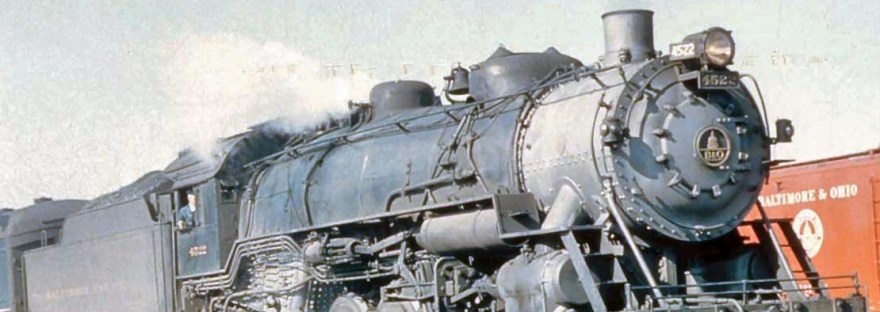
B&O Class Q-3 #4522, 1956, Baltimore. North East Rails Collection, Baltimore & Ohio (B & O) Steam Roster (the location on the website caption is believed to be incorrect and the location was Cincinnati, OH) http://www.northeast.railfan.net/images/bo4522s.jpg
With this post I am going to try something new. Sharing a blog post about an incomplete individual model. It’s something I don’t usually do because I was used to writing and editing for the B&O Modeler. Most articles were stand alone and if we ran a two part, it was usually because of space limitations, not that the model wasn’t finished. I like the style of successful and very informative modeling blogs like Rick De Candido’s and Eric Hansmann’s, as they share smaller bite sized posts. They keep my interest in modeling high, especially during the summer with so many more leisure activities available.
One of my first sound equipped HO locomotives in the early 2000’s was a Broadway Limited Imports (BLI) USRA Light Mikado. It would run under the Christmas tree on my small, circular HO layout for hours under DC power. I later added a BLI “black box” that connected to the layout wiring to let me control the basic sounds. I was hooked on sound and knew DCC with sound, though expensive at the time, was in my future.
The B&O had the first USRA Light Mikado, #4500, and it still exists at the B&O Railroad Museum in Baltimore. It was unique from later builds in a few ways including the cab shape and cab size. The BLI model is a more generic USRA “common build” model. The B&O changed many things on their USRA Light Mikados (Mikes in B&O parlance) over the years and classed these locomotives, Class Q-3. The most visible changes to their USRA Mikes included; adding an extended cab on the fireman’s side to accommodate a seat for the headend brakeman (this was done on many B&O Mikes), a twelve bolt smokebox front, a high mounted headlight, number plate or B&O Capitol Dome in the smokebox center, and the bell moved from the smokebox to behind the sand dome. There are more and I will add them to the conversation as I add detail parts to the model.
All B&O Mikados or Mikes were in the Q-series of locomotives. A great source of information on this B&O series of locomotives is Q The Definitive History of the Baltimore and Ohio Railroad Company’s Q-Class Mikado Locomotives by by Howard N. Barr (Author), William A. Barringer (Author), Harry C. Eck (Contributor), Charles S. Roberts (Contributor). It offers multiple pages on each class with information about when they arrived new and how they changed over the years while in company service. It was published in 1978 and is long out of print, but often available on Amazon and other used book seller sites. I saw five available from $30 today.
My 1950 Old Main Line (OML) layout needed a Mike for the local or peddler freight. Most of the time a Q-7f was assigned to this duty. Modeling this engine is difficult as it has only been produced as a brass HO model by Precision Scale a number of years ago. They now sell for well over $700. I have one now that I am modifying to look like #4844, which was photographed leading the peddler in my era. B&O Q-4 Mike locomotives were photographed in my era as replacements for #4844 and it seems reasonable that a B&O Q-3 Mikado may have also been assigned to this service when needed. My trusty old Broadway Limited Imports (BLI) USRA Light Mikado was one of the first Mikes to pull the peddler freight on my layout version the OML and has served well. This locomotive has been the main test engine for my layout, if it could make it through a turnout or curve, I hoped everything else could also. Most of my steam for my Old Main Line layout will be Mikes, mostly brass Q-4 and Q-7f models as that what was present in 1950. Through freights will also sometimes be handled by early diesels.
With this BLI model getting older, the drivers slipped out of the track a lot due to sideplay, so it was a good test for bad track work. And I ran it many times through new turnouts, curves, and testing operations, in fact, after it recently derailed through a new crossover, I took it to the work bench to look underneath. The plating has worn off a driver or two, the springs appear to have disintegrated, and the bearings are loose enough to allow a lot of sideplay on the main driver. Fortunately, these models are available on the secondary market and for less than $200 I was able to replace the entire drivetrain. The stock decoder had some glitches and my JMRI programming track couldn’t overcome them after repeated resets. So, while I was at it, I took the opportunity to replace the stock DCC and sound equipment with a Soundtraxx Tsunami2 TSU-2200 Steam 2, a Soundtraxx 810140 CurrentKeeper, and upgrade the speaker to a Scale Sound System (SSS) Force Full Range speaker. I chose the SSS 12mmx25mmx25mm, FFST -1225-RC1 to get the biggest speaker box possible into the tender.
The tender body is a press fit, making it easy to remove and put it back in place to make sure the parts fit. The blue and yellow wires will power the tender’s rear light when connected to an LED.
I was apprehensive about touching the DCC and sound in this model as while it is not the greatest DCC sound decoder available today, it never failed to at least run in over 20 years of service. But all that running took its toll on the model and probably the electronics, so maybe it was time for an upgrade. The drivetrain seems to be relatively universal to any similarly aged version of this BLI model, so I sought one on the second hand market, hoping to just switch the drivetrain on my B&O detailed boiler shell and possibly using the same tender.
The second hand locomotive I purchased was about the same vintage and decorated for the Texas and Pacific (T&P). It was advertised as having DCC/Sound, but when it arrived, the tender only had a set up for DC, no decoder or speakers. The seller refunded me some funds to purchase speakers and I figured I was eventually going to update the decoder, so no time like the present.
I always knew I would update the DCC/Sound unit someday, along with other detail upgrades. This was a future project that became a “now” project as I wanted to have a simple, reliable locomotive to test my growing layout. And when you start taking things apart, it is hard not to upgrade them to your vision of “good enough”. But I will share the detail upgrades in future Part Two post.
I was able to reuse the wiring harness and traced every wire back to its origin in the boiler and made the connections in the tender electronics through the original wiring harness. I did add a short piece of black shrink tube first to make the tender to locomotive connection look like a black pipe, possibly representing the stoker. The key to the easy installation was having the right parts. They all fit easily onto the tender base. I made a raised platform from styrene about 3/8” high on the rear of the tender base behind the speaker to mount the decoder and capacitor to avoid fouling the original connections to the trucks. The main purpose is to allow easier access for future maintenance. I’m sure I’ll have to replace or adjust something in the future if I keep running the engine, which is the goal!
One of the big obstacles to recreating a later era B&O Q-3 is the addition of front end brakeman’s seat on the fireman’s side of the cab. I want to mention that I hope to be working with a fellow modeler to create a printed cab to fit the BLI USRA MIke. The original cab is a friction fit and I was able to replace mine with a resin part that has not been available for many years. Hopefully a new part will be available soon if you are thinking about a BLI USRA B&O Mike for your collection. Let me know if you have interest and I will pass that along.
I will end this post with a short video of the Mike in its half finished state, but with its sound system complete. I believe the SSS speaker and Soundtraxx sound decoder make a big difference that is audible in this iPhone SE video. I hope you agree!
The less than detailed BLI USRA MIke with its new Soundtraxx Decoder and Scale Sounds Systems basic speaker.
This part of the Ilchester railroad infrastructure seems to be fairly short-lived, it was around in my era of 1950, and very camera shy. It appears in parts in only a few photos I can find after years of searching. It is the raised Freight House on the left side of the photo, railroad east of the station. The B&O always ran east to west and always had a north side and south side of the tracks, regardless of what a compass indicated. On the B&O, Washington, DC was not south of Baltimore, but west.
August, 1952 photo of Ilchester Station and Freight House, B&ORRHS Photo Collection.
This might be the best picture that exists and it appears to be from August 1952 according to one caption. The board and batten siding and peaked roof are not things found on many eastern B&O structures.
My guess is that this station, its freight house, and coal trestle were originally built to serve the local community. Baltimore had some of the earliest “suburbs” in the nation. Areas like Roland Park were built in the 1890s and even had one of the first shopping centers. It was served by street cars and I suspect it served as a model for future possibilities. Pure conjecture, but early photos of Ilchester show long wood passenger platforms on both sides of the rail along with the coal trestle that could serve local coal deliveries. I wonder if the B&O thought Ilchester could become the next suburb served by passenger trains into the city? The station and infrastructure were built after the 1903-05 realignment, maybe adding the station was hoped to serve more than the boarding school or convent on the top the hill behind the station. The history of this area is not well documented and the effort of several modelers have served to add to the knowledge base. County historians look to fellow B&O modeler John Teichmoeller for definitive information about this community.
Photograph origin unknown.
Ilchester, MD 1941. Herb Harwood Photograph, B&ORRHS Collection.
How to model this elusive freight structure? Photos show board and batten siding and the building on a raised platform. The overhead view shows a peaked roof structure about 1/4 the length of the station and half its width. Their are standard B&O plans for a 16’x 20′ freight house, so maybe that size is appropriate. I know modelers build on less information and this may be all I ever find, so that’s what I am going with. On the up side, as soon as I complete the structure we all know a new photo will turn up. If so, at least the historical record can be set straight and I’ll have another structure to build.
There is a similar freight house at Dickerson, MD on the Metropolitan Subdivision and I used photos of it to supplement the photos of Illchester I found.
Dickerson Freight House and Station on the Metropolitan Branch. Underwood Photograph, Barriger Collecion.
Using the rough dimensions from the overhead photo, I constructed the 15’ x 24’ raised wood platform from an old plastic kit from an unknown manufacturer. It was very close to the construction and dimensions of the platform in the standard B&O plans book available from the B&O Railroad Historical Society. The plastic kit was supplemented with scale Evergreen “lumber” to enclose the lower part of the structure which was painted a dark grey/black brown.
The platform from a very old kit, and Evergreen dimensional “boards” to enclose the platform.
The steps were from an old Campbell kit, but these are easy to replicate with styrene or scale lumber. They were painted the same color as the platform.
For the structure, I found another very old kit at a train show that had lots of board and batten sided parts along with a bunch of windows and doors for future projects. It took a while, but it’s always good to have something inexpensive to find at a train show or new hobby shop.
I cut the siding pieces to create 23’ x 12’ structure with a 8’ x 8’ opening for the door. The door is Evergreen styrene scribed siding painted the same black as the trim. The roof is .060 Evergreen styrene and I matched the roof pitch of the station building to mimic the photographs. The base trim boards are Evergreen styrene strips.
The roof is .060 styrene with the edges painted black to represent the trim boards.
The roof was covered with faded black construction paper to simulate tar paper roofing.
I used the same paint colors as those on the station for my rendition of the Cream and Black colors I remember seeing on old structures painted in this combination. It also matches favorably the Cream color shown on a 1939 paint chip card I received in an email some years ago. To match it, I airbrushed Vallejo Model Air 71.270 White (it is not a pure white) mixed with 10 drops of Vallejo Model Air 71.244 Sand Beige added to the almost full bottle. For the Black trim I used Vallejo Model Air 71.251NATO Black, it is a weathered flat black that has a slight brown hue that matches my recollection of the color.
Looking across the mainline tracks at Ilchester from the north.The back of Ilchester Station and Freight House looking north from the parking lot. I added the freight agent as he appeared in the first photo of this post. Detailing the figure was covered in an earlier blog post.