
Some parts of the B&O Old Main Line (OML) remain and remind us that this was not always a shortcut to Baltimore from the west. It was built as a permanent structure to move freight from the middle of the country to its ports in its first 50 years of existence.
My layout is set in August of 1950 and I am trying hard to duplicate the look of that era. Cinders abounded and spread out along the right of way and there was an effort to catch up on deferred maintenance from the Second World War, which took its toll on the right of way. And even by 1950 the OML was still recovering.
On my first “TOMA module” of the Old Main Line, scenery shapes were formed with one and two inch insulating foam cut with a handheld drywall saw to create rough shapes. Messy, and I had to keep a shop-vac handy. I covered them with a Scluptomold mix, now often described as “Scenery Goop”. Not that I have anything to do with its current widespread use, but I have been using this since I was 12 years old. The owner of my local hobby shop recommended it for model armor dioramas and I thought it would be useful for model railroad scenery. At the time plaster and zip texturing was the conventional wisdom for layout scenery.
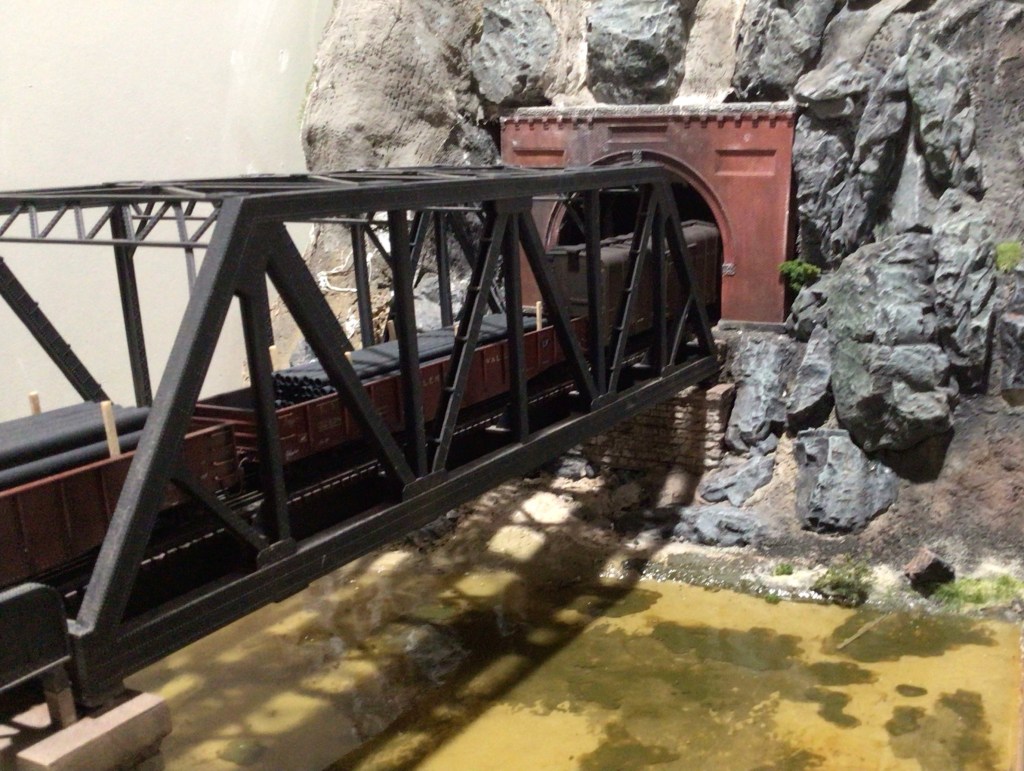
The tunnel portal on this first module has the classic or cliche train layout look of protruding rocks surrounding a tunnel opening. In this case it is the prototype. The Patapsco River flows east to the Baltimore harbor and hits this granite hill, then turns south, and goes around it leaving exposed rock and barely enough soil to support some trees. The railroad followed the river until early 1900s realignment and a tunnel was bored through the hill. To model this steep cliff face I used a variety of Woodland Scenics molds to cast sharp rock outcroppings to simulate the location. They were covered with black paint for a background, drybushed with light grey for highlight, then lightly over sprayed with a light green to simulate the moss that grows on them in the damp valleys of the US Piedmont. I tried to place them similar to the prototype and filled the area in between with goop, Woodland Scenics clumps, and parts of Scenery Express trees were added to simulate the trees that struggle to exist on rocky outcroppings.
The tunnel portal is a very accurate commercial product by Monroe Products (#151 Tunnel Portal Brick B&O style, Double Track) that replicates the brick tunnel portals the B&O used at multiple locations along the Old Main Line. It is a hydrocal casting that I stained with box store acrylic paints thinned with isopropyl alcohol.


Ilchester Road appears to still have been a dusty, dirt road in 1950. I modeled it with light colored grout to match period photos and the unpaved areas that still exist in the area of the bridge. I added a thin layer of grout then treated it like ballast, with a covering of thinned water and white glue. I added tire tracks to the underlaying layer of sculptamold. The trees are actually curved away from the tracks as the cinders and debris would have kept them from growing too much closer to the tracks. They are Scenic Express trees I coated with various shades of medium and light greens to replicate trees that are still growing, near the end of a a hot, humid summer in Maryland. Late July and August have always meant 90 degree plus temps with 80% to 90% humidity and afternoon thunderstorms. Not great for some humans, but another growth season for vegetation. Having spent some winters in Pittsburgh when the B&O transferred my Dad, I alway love July and August for its hot weather.
Vegetation along the right of way is something I get to study almost every day. I live about 15 miles from the B&O’s Old Main Line and much closer to the PRR’s old Northern Central Railway line. They were constructed within a few years of each other, each following a river. One is still an active rail line, the other is a rail trail that starts 600 feet from my house. I try to walk 3 miles every day and I often ride my bicycle on the trail much further. Having worked on and more recently walked portions of the Old Main Line, I can attest that the vegetation is very similar.

The steep bank to the right in the prototype photo above looks like it is covered with Woodlands Scenics ground foam. I see this everyday on the NCR Trail. It seems like a cop out to not use some new technique for scenery, but ground foam with some variations in size and color, along with some smaller trees actually seems to replicate this right of way well. Like the NCR right of way, the OML has large granite outcroppings. The are dark grey with lighter edges and often tinted green with moss and other organic coverings.

Ballast is another topic that is best covered in a brief way. When you’re a trackman on the railroad, ballast is part of the job. You learn how to make sure it is solid and on production gangs with big, mechanical ballast tamping machines. But back in the 80s, you still learned how to use a ballast fork to tamp a tie by hand. One guy on a lining bar to raise the tie and two guys, one on either side of the tie sliding their tamping forks under the sides of the tie to add ballast underneath until it was solid.
HO scale ballast is more decoration than function. One tries to replicate the amount of ballast present on different tracks to show usage or importance. Today, mainlines are often maintained by large machines to tamp and level track. In previous times this was often done by section gangs that were responsible for a certain distance of track. I got to work on a section gang a few times on the OML. Even in the 80s there was a lot of pride taken on the look of the mainline. I never saw anyone leave a stone on top of tie, it was cultural no-no. Something you just don’t do!!
The ballast I remember on the OML from the 80s looks like the ballast today and how it looked in color photos from the 1950s. It was white to very light grey limestone rocks, about 2 inches in diameter, very roughly. The rocks weren’t as big as my foot, nor were they as small as my finger nail. They were more like a rock that could fit in your hand with a closed fist. Older 1950s era photos show a similar maybe slightly smaller stone, but the color is seems consistent.
Another unique part of the OML are the old walls, stone ties, stringers, and bridge abutments found along the right of way, many not in use. In this modern photo (below) of the tracks between Ilchester and Ellicott City there is a retaining wall still doings it’s job, probably 100 to 175 years after it was built. I chose to add this to my layout to offer some respect to the men who built this line to Ellicott City back in the 1830’s. I used a Chooch product, 215-8250 to replicate the wall. It still needs some weathering to fit the scene and there is obviously a need for cinders and some vegetation.


I wanted to add more detail and photographs to this post, but that just means waiting longer to post something new. I will follow with photos of completed scenes. Thanks for taking a look.

 B&O Modeling
Good morning Bruce,
<
div> Looking very good. As well as being historically correct. The tunnel portal scenery is great. Thanks for sharing, Barry
Sent from my iPad
<
div dir=”ltr”>
<
blockquote type=”cite”>
LikeLike